Showing posts with label New Salem. Show all posts

Thursday, August 8, 2024

New Salem: Renaissance - Supers Modules and what did we learn

After a month spent on this I think I have a few observations on what I in particular am looking for in a supers module. 

  1. If it is designed for an existing supers property...
    1. Iconic: I want it to thread the needle between what is iconic for that property and its history and being portable to different heroes if that's what the purchaser needs. The MSH Modules Lone Wolves and Time Trap were both really good for this, and Don't Ask! managed in in a different direction, where your heroes had an Ambush Bog story invade their normal affairs for a while, just as he did in DC. 
    2. One and Done: Since its unlikely you're playing an ongoing campaign with the the heroes in that supplement - not impossible but unlikely - it should have the assumption that this is a one shot/con game that focused people can do in 3.5 hours. You can have a bunch of optional stuff in there, recommendations for if you have more time, but the idea should be you are getting together one day to run this adventure for these heroes, and then like the Leverage crew all walk off in different directions. 
  2. If this is a Scenario (rather than a Supplement, see below)...
    1. Modular: You can drop it into any existing campaign as an outside event happening to the PCs, just as Don't Ask! does. There needs to be a clear on ramp for any group of PCs to enter into it - it shouldn't involve Generic Government Agent giving them an infodump and pointing them at the problem - and a reasonable way for them to skip it if t's really out of character. Now, they likely won't skip it because of table contract, but the fact that it is skippable makes it something you can insert into a sandbox game, with ramifications.
    2. Clear Stakes: The stakes need to be clear, self-contained, and optimally low for the broader game. This lets the GM either drop this in as a two issue event or an annual and everyone knows the wheels are on the rails. Of the GM can easily modify it so it's a seamless part of the game, foreshadowing and integrating it as part of the sandbox. That increases utility. 
    3. Classic and Clever: Scenarios should be riffing off classic tropes as a way to show the GM how to do this sort of thing and let the players experience the types of stories they love with their characters in a well presented way. They also need to not be completely generic. Terror By Night lets them fight a vampire and do the circus thing, but has some nice twists to break it up. Enter the Dragons Claw: HONOR is you fighting Ninja! But it's also 1980's high finance business politics. A scenario should always have a neat spin. 
  3. If it is a Supplement...
    1. A Single Book: I know this wasn't the style at the time, but if Death Duel with the Destroyers and Island of Doctor Apocalypse (or FORCE and Assassin!) had been a single longer book, with the lead in stuff that Dawn of DNA had for the hints of the organization (but which fell down on the master plan) you would have something ideal. A clearly defined villain group that had plans and fall backs and ways for the heroes to encounter them again and again, and maybe get ahead of them to give the players real agency.
    2. Easily Integrated: Supplements are bigger than scenarios in that they define a larger part of the milieu...nope still feels weird to use that out of D&D... game setting and therefore they need to be pretty easy to integrate into anyone's game. The design of smaller teaser encounters before one of the big plots kicks off. A n explanation for how the group had stayed under the radar for so long or had just been created. How the villains interact with the world in a general sense.
    3. Sandbox-y: This ties with easily integrated but while Scenarios should be a little sandbox in that the players can just ignore them and their limited stakes play out, supplements should be sandbox in that the seed the setting with stuff. FORCE and Assassin together present several different plots going at once under different identities and umbrellas. Make the GM aware of all of these and their respective time tables so if the heroes go somewhere they may stumble into something. Also the information on the group should make it clear how they would react to another group either from a different supplement or the GM's campaign - how would Force react to Doctor Apocalypse, or vice versa? 
  4. In all cases...
    1. Supers adventures need clear organization: The DC Heroes lead-from-the-front synopsis to the GM about what is going on is a huge deal, as is their flowchart and the "troubleshooting" sidebars. That being said the flowcharts need to have more options to get from A to Z, with things the heroes might skip, branches of investigation, etc. Modern mystery design from Gumshoe games are a big help here and should be emulated in the way to start ay A, end at Z, but many paths to it, and enough information for the GM to end at M if that's what the PCs do. The ideas of how the big final fight should be explained, but not made mandatory. I know the genre conventions lead to certain things, but a troubleshooting bar of "if the PCs figure this out faster than you think, alternate endings are..." 
    2. Investigation needs to be part of it: Lots of heroes have detective skills or information discovery powers, and the adventure should have those. Just going straight to  When it comes to the information gathering beats, the GM should get a clear list of the names of the people who might be questioned and what they know (as MSH did in Lone Wolves, and DCHeroes did in City of Fear, and kind of needs to do with the mechanical nature of DC's interactions).The classic V&V modules only do this in the most cursory sense, but I think it's needed to capture the investigation pillar of supers. 
    3. Maps are Neat but not Needed: I love the location maps for the V&V modules, especially the area maps with points of interests, but the room by room maps with descriptions feel like holdovers from the D&D design era. We don't see supers in comics doing room by room searches of places (unless it's the funhouse in Terror by Night, which is part of the plot), especially if there's a time limit. If the base matters, give it in broad stroke areas and what's likely to be in there, with where the villains are and how the base responds. We don't need every room detailed. (also there were a lot of clues in rooms that PCs might never enter, making it easy or hard to solve certain plot points based on whether the PCs tore every room apart, or it all happened off screen after the last fight? This is a place where more abstract works. 
    4. Theme Matters: When you're building your villains, try to give them a coherent theme based on the setting or scenario. If your fighting Ninja they should all feel Ninja-y, your not what he seems Vampire should have similar sidekicks, etc. The useless side bit in Assassin! investigating the bio-engineering place would have been 100% better if all the security guards had powers based on the place's work rather than being hired supers guarding this isolated business. the Dr. Apocalypse series would have been better served with the Elementals portrayal of the doctor making them rather than recruiting them. If Dawn of DNA had been a Supplement you could have started with the Aberrants because that's all Doctor DNA could fine, and then newer created supers or recruited heroes could filter in over time. That the Organizer's supers in Organized Crimes are not under his control fits when the middle bit relies on that team falling apart, but the ad hoc nature of the villains in Battle Beyond the Earth does not. 
    5. Don't play favorites: Please don't have a favorite NPC who centers in the module. Just don't. I shouldn't need to tell you this. 
I think that's it, but will add more if they come to me. 

Wednesday, July 31, 2024

On Ragged Universes, Team-Ups, and Supers Gaming

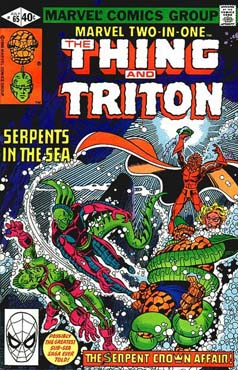
I know I've commented on edges of this before, but here goes: at the flea market this weekend I scored a couple of my current targets - pre Crisis/pre-1988 team up comics - in the form of a DC Comics Presents #39 and Marvel Two-In-One #65. As I get older I have a deeper nostalgia for these sorts of tales.

George Perez on one, Ross Andru on the other
But more important is Plastic Man artist extraordinaire Joe Staton doing the interiors for DC

The thing i love most about these stories, moreso on on the Marvel side, is how disconnected they are, but aren't really. Let me unpack that. These books are designed for one popular hero and a rotating cast of second heroes. These should all be stand alone stories because the team up hero changes. 

On the Superman side the feel of each issue is determined by who he's teamed up with, so this really feels like a Plastic Man story more than a Superman one. And my sense is that DC editorial would pitch "we need to boost this character or complete this unfinished story" because DC always, always cared about that continuity hole stuff. DC feels like cleaning up untidy bits. 

But often in Marvel they aren't just one off stories. They are these weird things like Marvel Two-in-One where the Thing teams up with people. Here the FF are approached by the aquatic hero Stingray to assist someone who needs to meet the Inhumans, and Thing volunteers to take him, and they get attacked on the way. That was last issue. This issue Stingray is unconscious and Thing has to save them from a deathtrap but is helped by the Inhuman aquatic hero Triton. They beat up most of the bad guys, but said bad guys got away with the MacGuffin that had NOTHING to do with Stingray's mission. So Thing has to take off after it and teams up next issue with Scarlet Witch to get the MacGuffen back, and then lock in in Project Pegasus, which turns up in MTiO a lot. 

Now, this is kinda crazy. Stingray to Triton to... Scarlet Witch? 

More importantly, next time we see the MacGuffen, er, Serpent Crown, is in Marvel Team-Up, Spider Man's team up book. where he team up with Thing and Scarlet Witch, but also Dr. Strange and Quasar. This issue is 2 years later. These are all Mark Grunewald picking up and running with a story threat that Steve Engleheart started five years before that, where Engleheart being Engleheart had the villains be an evil Oil Company because it was the 1970s and he had just had the head of the Secret Empire be Richard Goddamn Nixon. 

That's quite the crew

What I'm getting at here is not just the ragged and unplanned nature of the comics in general, but the free-wheeling nature of the team-up books in specific. Marvel had a small stable of writers and a lot of experimental books that lasted a year or two, or characters that rotated through their Marvel Premier, or Monsters on the Loose or any other weird book they were running. And for these the book would end, and the writer would of their own accord carry the plots to the next book they were working on. And these would often be the team up books that were popular for the central character and kind of muddle along. And led to these sorts of ragged, organic stories where heroes bump into each other and we accept the strangeness of it because comics. 

So much of this got lost when comics started organizing more - the next time we see the Serpent Crown it's in a 14 Annual crossover for the whole Marvel line - and I think it's to the genre's detriment. Ron Edwards goes into the the blessing of this making it up as you go unfinished story style in Champions Now, which for all it's issues is audacious as hell. He really wants you as GM to lean hard into this feel. 

I'm going to chew on this a bit along with the Weird Tales game frame and more on the New Salem setting, and more on module design. I swear this stuff is coalescing. 

Wednesday, July 24, 2024

New Salem: Revolution - module retrospective on Marvel Super Heroes modules

I know these aren't connected to V&V, but I feel like I'd be doing this project a disservice if I didn't do a little compare and contrast on what competing products were being published. So here are the three Marvel Super Heroes adventures I have on hand. (I also have some DC Heroes adventures that I'll look at next week.) These are for the Basic version of the game and all came out in 1984. I know I owed the first 5 of the adventures but my copies of Breeder Bombs (for the X-Men) and Murderworld (For the FF) are lost to history. But if memory can be trusted, they don't bring much different to the table. 

Hot Damn do these look pretty, but when you can get John Byrne to do your cover art
in the 1980'syou have hella more resources than FGU...

The three modules are Time Trap (Kang pretends to be Immortus to get the Avengers do undo their own history), Lone Wolves (AIM is planning several attacks on the city and Daredevil/Black Widow/Heroes for Hire stumble on a thread of the threat), and Cat's-Paw (Alpha Flight deal with the Leader's complex plan, and things past that). Each of these is designed to look and feel like the adventures of their target heroes, which since it's MSH is to be expected. I go back and forth on playing existing heroes, but generally if you're playing Marvel Super Heroes of DC Heroes my experience is the game runs better if you're playing existing characters. YMMV

But the question is are these any good? Ehhhhhhh.....

Time Trap is GREAT when it comes to tying in existing Avengers lore. All of the sequences link to certain moments in Avengers history, and in one you can point to the actual damn issue where the PCs are messing with their own timeline. As a comics nerd this is just golden - I used the skeleton of this adventure in my own X-Men game as an "annual" where the current PCs got to team up with the original team where Kang was manipulating them (plus Scarlet Witch, who was on site) into undoing the Avengers. Wonderful, so much fun. 

The module as writ is a straight line railroad of nothing but fights: Immortuls (secretly Kang) shows up, explains a "problem" and sends the PCs off to fight Mimic. Win or lose he whisks them back, and then sends them to fight Drax. Then Super Skrull, Then Grey Gargoyle. The the real Immortus shows up and sends them to get a dohicky to undo this. Then they fight Kang and Dragon Man. Yay. There's no space for the PCs to breathe, no role playing, no detective work, just fight after fight. It's a mess. 

Lone Wolves does feel like a crossover of 2 issues, or two annuals, of the Power Man/Iron Fist and Daredevil (working with Black Widow) of the mid 80's. It's still VERY linear, with AIM/MODOK having hired Kraven to run a field test of their rage-toxin, and Kraven using Sabertooth and Vermin to front line the event. The book acknowledges the heroes have Contacts, and the general data those contacts give, and then a lot of possible clue trails for them. The module sets up how those clue trails lead to Kingpin as the last information source, but that the Punisher is also murderously running this to ground and several places where he and the heroes can fight. The assumption is that the PCs will get Kraven's hideout from Kingpin but you don't have to. I really think it's better if you don't. 

Having used their actual in character skills to get to Kraven the PCs have to break into his predator infested base and defeat him (and Sabertooth and Vermin if either got away) to find out who hired him and created the rage toxin. This gives the name MODOK, and now the PCs have to do a bunch of detective work to find the AIM base, which again loops back to Kingpin and a much more in keeping "I'll tell you where MODOK is if you stop this crime being perpetrated by one of my rivals" quid pro quos that feels VERY 1980's street level Marvel. Once they have AIM's address it's a sneak/fight into the base and deal with Taskmaster and MODOK. 

There is a lot to like here, in that it feels like a Feng Shui module of set piece fights held together with investigations. The GM is given various options, the players can use various paths, and as long as you edit out the first Kingpin instance (though the PCs might go there for questioning) it's no more or less railroady than a classic Call of Cthulhu adventure. Yes, there are strong assumptions that the PCs will get involved (too much verbiage in how the riot in scene one gets ever out of control until the PCs do something) but not the abuse of PC stuff that we saw in some of the contemporary modules. Rereading this now, I kinda want to run it. 

Cat's-Paw opens with the PCs being sent on a mission by their government contacts; an old manor house that contains high tech equipment guarded by Sabertooth and Constrictor. Yeah, Sabertooth again. This was before his X-Men Days, but at least he and Constrictor have worked together in the comics (Power Man & Iron Fist) and in Canada (in Iron Fist's solo book). Win or lose the heroes find one clue that leads them to the James Bay Hydroelectric Dam, where they are caught between two different villain groups - Mauler and the Raiders, and a pair of Synthetic Hulks - and a just introduced NPC gets kidnapped no matter what the PCs do. Interestingly, if someone is playing Sasquatch he might also be teleported away and the PC provided a different Alpha Flight hero. That's an interesting comic book twist. 

In any event the only trail leads to Justin Hammer's base, where they fight a bunch of his revamped tech villains before he hologram monologues at them about "The Other", the person responsible for the synthetic hulks. But there are no leads until a new villain shows up, created from the NPC inevitably captured 2 fights ago. This gives the heroes one clue to get to the Leader's base, to fight him and find that he is being manipulated by a new Great Old One, the big bads in the Alpha Flight comic. Cue big fight. There's even a "how the NPCs solve the problem if the players fail twice to make sure this doesn't end the world." 

Yeeeah, this one I have no interest in running or modifying. Yes, it has some Alpha Flight elements in it, but the plot is completely linear, the players have nothing to do with solving the mystery, and the collection of opponents makes very little sense. 

What do these adventures tell us? Tune in soon, true believers!

Thursday, July 18, 2024

Quick Art Recap on Alone Into the Night

I commented in yesterday's post about the Zircher art in the Alone Into the Night module, where two of the three spalsh pages for the short one hero adventures are kinda bangers. 


Both of these really catch the tone of the adventures in question, drawing on specific elements from them. Just fun stuff that you can easily see as the the cover of that months issue.

Wednesday, July 17, 2024

New Salem: Renaissance V&V Module - Alone into the Night and Organized Crimes

This is the last of the V&V module retrospectives just because these are the last of the modules I own (I also own the villain sourcebooks but those aren't as useful for my purposes here). This time we're looking at Alone into the Night and Organized Crimes, both from Ken Cliffe (also responsible for HONOR and the Super-Crooks and Criminals supplement) and with art from Patrick Zircher. I hadn't realized until working on this series just how much content V&V had from 1982-1985 - 21 items from the rulebook through the Trouble for Havoc shared system adventure with Superworld and Champions). Since I didn't get them all at once but in pieces from 1983-1994. These two came at the end of that, purchased when one game store bought the stock of another disorganized game store and had these somewhere I could see them (along with TOTEM). 

Again we are looking at Zircher art, which is always so crisp and clear
There are two really nice splash pages in AitN I'll add later

The two modules aren't linked so I have to tackle them separately 

Alone into the Night is a collection of three solo adventures for GM and 1 PC, which is a style of play that works very well for supers. Super characters have a high degree of presumed competence, a wide latitude for how they can solve problems, but a clear set of expectations on what they are supposed to be doing (which V&V tries to reinforce with it's Alignment and Charisma systems). All three have a mystery element to them, but the first is a sort of horror mystery, the second a crime story, and the third a more standard comic book nonsense. None are great as mysteries because the author doesn't know how to structure them in a way that doesn't feel railroady. 

This makes the first (co-created by Kent Pauling) is a series of set pieces when it should more properly be an expanding incident: in the 1930's there was a serial killer in Our Fair City named the Garrote who, um, garroted people, and left pennies on their eyes. Shot by a police officer who stumbled onto a murder scene, Garrote escaped observation and vanished.  Since the murders stopped he was assumed dead. Rumors have swirled in the decades since that  the Garrote's costume and weapon were hidden in the cornerstone of the then under-construction Mayfair building. That time capsule is being opened 50 years later. There are 5 people who have an exceptional interest in the contents, several of which are tied up in a legacy/blackmail scheme. But instead of there being a roughed out timeline and motivations there are a lot of crimes the hero can't stop, murders they can't prevent, and a set piece fight scene at the end (admittedly in a neat locale). It just feels forced. 

The second is a political/business thriller, but it too is a series of set pieces of a different type -The PC has to be at the movie theater in their secret ID for the reporter on the run to drop an audiocassette into the hero's pocket before being shot down in front of them when exiting the theater, clutching a card with an address on it. Nothing the PCs do will save the reporter. Capturing the gunmen won't reveal any more information than what is already on the tape. The card leads to a "hero vs. hero confusion battle" where the PC encounters a grim vigilante pretending to be criminal to infiltrate the gang scene, but reveals where the person named on the tape is hiding. No other path will let the PC know where the <checks notes> industrialist leader of a major corporation... might be. Then the PCs is assumed to confront the person who ordered the killing, and fight his super-bodyguard as the industrialist tries to escape and disappear. Again it's all so forced, like 1990's level railroading a decade early.

I do want to give props on one thing: these two both give breakdowns of what happened in the playtest games and while #1 ended exactly how the story would have ended in any comic book with the player unable to stop the events, the second ended with a legit PC failure that doesn't read like railroading but the stakes of the adventure being explored and failure having ramifications. But the getting to there doesn't feel fun. 

The third is just a mess. Like literally a mess. Like "of course the player-hero will not understand much of this when he/she sees the computer printout. It's always amusing to see a player deal with the frustration of attempting to decipher a possible set of clues." level mess. The adventure is full of indecipherable data, lack of clues, and then responding to another attack. Since the villains plot is both high stakes (control of Canada) and absurd (by murdering all the candidates for Prime Minister via his super villain team), it's just <tosses up hands in frustration> 

There are two workable ideas here but both need a ton of work. And in all cases the 1980's convention of writing up the adventure as if it were fiction for the GM, who will enjoy learning things as they go and being surprised by the endgame in their prep, is rampant. (And happened in HONOR too....). At these there are modular and fill and common need. 

The on to Organized Crimes... which is a very odd beast. There is absolutely no introduction, to the GM. It opens directly with the PCs assisting with a high speed chase between fleeing robbers and slowly opens into a highly organized smuggling ring with the leader, the Organizer, and his group of super-muscle who are... ummm... kinda emotionally disorganized. The PCs are eventually able to disrupt the Organizer's smuggling ring but he escapes and starts a new plan to pit the local criminal gangs against each other and then consolidate the remnants and claim total control of the city's underworld. The players trying to stop this is disrupted by members of the Organizer's villain group (escaped but partially disbanded) who seek revenge on the heroes. And for some reason the Organizer's back up HQ is in a circus in NYC Central Park, with the PCs having to fight circus members at the end. 

There's no way this modular, and it forces a lot of assumptions into the setting that might not fit the campaign. If this were presented the way Dawn of DNA was, with the Organizer's moves appearing disconnected, and his henchmen (and wow do the Midnight Men look like the Deviants from DNA in dynamics...) being somewhat of screw ups leaving him open, this would work better. Or if we just ended the adventure at the end of part one. Or if Part 1 and the Midnight Men also had a circus theme and the villain was the Ringmaster and not the Organizer... all of these options would make it more coherent. 

You could make the argument that updated any part of these could work for an NSR game - save for AitN part 3 the stakes are low enough that they could be inserted into play for a session and be followed up on. But there's a lot of reworking needed, or integrating these ideas into the campaign world before you start (as I did for the 3E Emirikol game). 

Wednesday, July 10, 2024

New Salem: Renaissance - V&V Module Retrospective of Battle Above the Earth and To Tackle the TOTEM

The second to last of my retrospectives on these, I'm covering two modules I owned but never used. Sometimes one doesn't use things because they aren't great fits for your campaign. In this case I didn't use them because... they just don't seem very good.

I'll admit BAtE has an evocative cover
TOTEM is done by comics veteran Don Heck
so they look good enough....
Both of these modules suffer from similar flaws: both are two-part concepts, and both rely on some aspect of the Charisma rules in V&V to place the PCs at the sight of the adventure. BAtE has a page of "here's how you press pressure your PCs into going to rural Wisconsin for this adventure via the charitable contribution and Charisma system" while TOTEM simply states "we open with our heroes as guests at the unveiling of a super-hero history exhibit at this museum, because we know this is V&V and you're all good-guys who would do that." Neither sits well with me, but at least TOTEM just cuts to the action with something reasonable enough. 

Both then have a long swath of player frustration: a completely meaningless investigation sequence in BAtE before the heroes get the right local to lead them to a hidden spaceship (and get ambushed along the way), or an EXTENSIVE bit of NPCs talking to each other where the PCs are strongly urged to not interfere in TOTEM before super-villains attack. 

In both cases the super-villains are designed to get away: there's no way to stop the scout ship's escape fight and all the aliens disintegrate in BAtE; all the villains are equipped with one use for this scenario high speed jet packs in TOTEM. Why did the villains attack? to get a dimensional transporter they don't need (literally, this is a favor for another branch of the organization and it has nothing to do with the module's plot). Why did they do it during the opening? Just because. 

TOTEM then has a bit where a new hero who emerged in the fight lays out where the villains came from/went, to lead the heroes to location/fight two - a TOTEM base in the American Southwest. While BAtE has the heroes contacted by their government liaison about the space station being taken over and loaned a space ship to get up there. No investigative aspects, just here's the path to fight location two. Add a bunch of maps for the locations, the super-villains in each, and away we go. Both have a ticking time bomb to world devastation (Aliens in route to use station as holding spot for their orbital destruction beam! The senator from part 1 is actually Gregg Hartmann from the Wild Cards books and has the Wild Card virus as missel warheads!) that the PCs have to defeat the villains (or lose, once again get put into healing pods, have a chance to wake up, escape, and try again...). 

Some of the villains in BAtE are interesting designs even if none of them have reasons for helping the alien invasion other than "we're jerks". The TOTEM Villains are either fairly generic and have a logical reason to be there or not so generic and don't. I do admit I like that Chillblade is there because TOTEM is showing off and trying to recruit her to get her Canagian criminal organization. That's a neat bit of worldbuilding. I also appreciate that TOTEM are just straight up Nazis. Their thugs are Brown Shirts.

I commented earlier that the villain in this reads as an EXPY of Puppetman from Wild Cards and their plot is the release of the Wild Cards virus, but the module was published in 1985 and Wild Cards was released in 1987. Granted it was based on George R.R. Martin's _Superworld_ Campaign that ran from '83 to '85 in Albuquerque NM - the general area of the TOTEM adventure. But Puppetman was created by Stephen Leigh, who lived in Cincinnati, and wasn't part of that game group. It's all deeply perplexing. Is this just random coincidence? Quantum Entanglement? Let me know!


Thursday, July 4, 2024

More on HONOR and Terror

Yesterday I commented on the art in the modules Enter the Dragons Claw: HONOR and Terror by Night. Done by Jim Holloway and Patrick Zircher respectively these really added to both modules effectiveness. I thought examples would be good.  First, HONOR 


These images really are delightful in capturing the somewhat goofy tone of Ninja fighting Superheroes. The garbage can Jack in the Box attack, the look of concern on the super heroines face, the ninja's toe braking out of the panel box…. Holloway’s art was so distinctive and memorable. This reminds me a lot of his work on Chill where the absurdity of monster fighting was just under the surface.

Next Terror:

Zircher's art here is pure comic book. I really don't know how much art direction Steven Crow gave to Zircher on these panels, but I would love to find out: was Zircher just given the module and told to draw what was in it? maybe. Neither Crossfire or Rocketman are called out in the Copyright notices as belonging to someone, something that V&V was very good at in the early days at least, so these are likely Zircher's original characters. Both of them feel 'right' in terms of name meeting design, you get an immediate sense of the characters powers and motif, and I particularly love how Rocketman's glove/armbands evoke the Marvel C list hero Torpedo while their outward feels like Kirby technology.

Both panels carry the funhouse vibe of this sequence of the adventure, including the "Wait! Something's wrong!" thought balloon. If either of these showed up in an issue of a comic I wouldn't blink and eye - not surprising given Zircher's later career. 

Wednesday, July 3, 2024

New Salem: Renaissance - V&V Module Retrospective for "Enter the Dragons Claw: HONOR" and "Terror by Night"

This may feel like a strange pairing for two V&V modules this week, but bear with me, because I think it makes sense. 

More solid covers - Jim Holloway is always fun, and his interior art in Honor is just a delight
Patrick Zircher is to me the 2nd most influential V&V artist.
 

I have a great personal fondness for both of these modules because I was able to run them with my college game group to the exact right effect. Why? because they are inherently Modular. Which is a big thing that the prior ones were not. The other 5 modules all postulated world changing events, mass casualty scenarios, etc. and two of them were sequels. Including these could radically change your game world if the heroes failed, so of course there's a strong strong impetus to make sure the heroes don't fail. (Which is mostly baked into supers as a genre, but even more so here). In HONOR, the stakes are an inter-generational power struggle for control of a Japanese electronics company that just some part of occurs in the PCs city to hook them. In Terror By Night a reformed vampire is testing the heroes capabilities while conventionally wooing a human woman. The stakes are just so much lower. 

The former feels like a guest author has taken over the comic for 2 issues. The latter feels like an annual. In both cases it's a disruption from the PCs normal plotlines to deal with this one off thing, and then resume normal programming. In which case, super-helpful for a GM who wants to take a break, or if one player wants to run the game for a couple sessions without breaking anything. Both of these are easy, training wheels modules. 

In my personal use, I ran HONOR over a couple of sessions with two players in college. They rolled up random heroes with an aim for "these should be Avengers level" and got some pretty archetypical heroes - a Flight Invulnerability Strength Speed Himbo with a Sneaky Royalty Cat Lady - and just jumped right in. 

The plot is pretty linear: the heroes see a news report about a corporate merger, stumble across an attempted ambush of one of the people involved, a request from that person for protection, a pretty slick kidnapping that shouldn't make the heroes feel stupid but can be stopped by clever play, and then a weird and unnecessarily complex turnabout ending. The stakes are super small; and will likely turn out the same if the PCs do nothing. It's useful for NSR play only in that the PCs can just safely ignore the whole thing. Plus the villains are generally cool, interesting enough for this sort of one shot fight... unless the heroes some day end up in Japan. 

Since Terror by Night is designed to test the heroes, and my college V&V game was the classic "players as PCs" it was easy for me to slot it in as their midterm exam. But even without that additional hook, the module it just a classic set of tropes where the Players will go "Oh! We're doing the circus thing!" and hopefully run with it. It doesn't so much fit the dark and gritty tone of of New Salem, but that might be seen as a nice break or a an excuse to ramp up the threat level in the various tests and have the villain vampire be as bad as villain vampires can be. There are a handful of "what you can do next" ideas at the end of the module if the players enjoyed it and want to see more; I like the open ended nature of it and made use of it in my campaign. 

I personally adore the leaning into the tropes, and just as Holloway's art in HONOR catches the slightly silly vibe of the whole ninja thing. Zircher's internal art here is just fantastic with panels of the sample heroes in the test chambers of the vampire's funhouse. Just great stuff! Again, it's completely trivial and modular, but as a module that's a good thing IHO.

Wednesday, June 26, 2024

New Salem: Rennaisance - V&V Module retrospective 2, looking at F.O.R.C.E. and Assassin!

Last week we looked at V&V books 2003 (Death Duel) and 2004 (Doctor Apocalypse), so this week we look at 2005 (F.O.R.C.E.) and 2006 (Assassin!) by Thomas Dowd. Which is just a little weird because there is a three-year gap between FORCE and Assassin!, in which a lot of other books came out (including Dawn of DNA, which we discussed 2 weeks back). Something was clearly up there....

Covers thanks to this nifty site

This two-parter has a very different style than the last one in that it is not intended to be played one right after the other, but instead for years to have passed between the two modules (maybe the delay was intentional! naaaah....)

First up, are these individually or collectively good for NSR style play? Ummmm....no. 

F.O.R.C.E. is a bit of a mess design wise - the information needed for the GM to understand things is scattered around the book, and there's an elaborate plot structure that feel a bit Rube Goldberg. 

The main villain, Franklin Orscar Randolph Charles Emerson (so twee!), is a wealthy industrialist who had his personality transplanted into a highly human android body to avoid a debilitating nerve disease, but the android brain brought with it both messianic delusions and a hyper-charisma psionics power, taking the name "Force". Now, we discussed Charisma at length earlier and this character is an interesting worked example of how that works, and Dowd goes into some detail of how and when Force uses his super charisma. When he really turns on the power Force gets a +9 on reactions, so a roll of 10+ makes someone very enthusiastic. That in turn gives a +3 on the Loyalty roll, and Force will use this repeatedly to get someone to the Enthusiastic permanent follower level. (I find it wonderful Force doesn't have Heightened Charisma B to take him to 46 Charisma, but has a psionic power to get there; it's not just a great example of how you can tailor your roll set in V&V to get the kind of powers you want, but also how the description of the power can do EXACTLY what you want it to do. However, it's also a way to get the Reaction modifier to apply for more than one roll.)

As an android Force has used inventing points to get a highly limited disguise power where he can change his height, face, eyes, and hair to look like other people, so he has three identities in the first adventure: Force the super villain terrorist James Bond villain, Emerson the industrialist, and Hieronymus Kinkaid the cult leader. The whole makes it clear that while Doctor Apocalypse dominates with brute power, Force is the Charisma/plotting/the law says you can't touch me/always has an escape hatch (he has back up bodies he transmits to if this one is caught) designed to frustrate the players. It's a classic archetype that comes right up against the "This is the GMs favorite NPC" issue. 

Somehow Force has stolen (either with his terrorist group The Force or through an agent created from Kinkade's cult) a nasty bio-weapon - and here we have problem one because the bio-weapon is so nasty that it circumvents the PCs super powers and kills them anyway if exposed, presumably to raise tension but mostly the writer undercutting the players abilities - and hidden it somewhere with a mid sized nuke (that they also presumably stole? and the bio weapon can survive being at ground zero of a nuclear explosion to be disseminated?) to blackmail the US government for $500 million in diamonds. Sure, it's comics, run with it, but we don't get an explanation as to why they want or need this, how they plan to move the diamonds, etc. Bio-Nuke Armageddon in 10 days unless the PCs do something (the threat is a secret, so the PCs have to have some way of finding this out via government contacts). 

"Several days before the final ransom deadline, after days of fruitless investigation" - and here's problem two because there's no way to predict the PCs powers or capabilities to say that they are stymied for a week - we have what should be the cold open of a journalist investigating the cult dying in the PCs arms with a croaked warning  - problem three, even if you revive the journalist he's still brain dead because how dare you keep Revivification as a power and mess up my plot - that gives them reason to tie Kinkaid's cult to the Force, and specifically a yacht off Long Island Sound. It would be so much better to frame this as "here's the way of last resort", or "this guy dying at your feet is what brings you into this scenario to begin with, the government contacting you after you stick your nose in". 

If the PCs instead recommend paying the ransom and trailing the pick up, they discover the pick up is done by a teleporter (named Teleporter) and the Force's not stupid strategies on how to avoid being followed. Still, there's nothing that says the PCs clever plans (like shrinking down and riding along with the diamonds or the pick up guy, shape shifting into the briefcase holding the diamonds, reading Teleporters mind, etc. 

Still, everything from here is "here is the route of the yacht and how it defends against PC action/ here's (another) Caribbean island used as the Force's base and how it defends itself, here's the Kansas commune and how it defends itself" that is highly reminiscent of Doctor Apocalypse and at least stands as a "The Heroes take the initiative, the villains react" style of play that sort of works from an NSR sense. It's just a shame that these spaces are presented in such a map-heavy manner. Every room is detailed as much as if it were an OSR dungeon. How to present these things differently is something I have to think about, because super heroes isn't dungeon crawling, but the GM still need some detail to put in front of open ended PC exploration. 

I did want to stop and look at the concept of Consequential Play in scenarios like this because the stakes in these modules are just so apocalyptic: the heroes are always trying to save the world. Yes, it's comics, but there needs to be some thought as to what happens if they screw up. There will be another blog post on this eventually. 

No matter how things play out the PCs won't be able to permanently capture Force because of his unknown at the start transmit to new body trick, but they can stop his plan, destroy his base, expose Kincaid's cult as being connected to the Force, and generally mess him up.

The next module, Assassin! doesn't even advertise itself as a sequel to F.O.R.C.E., with the PCs being called by their government handler to protect a senator/presidential candidate from an assassin (code named "the Assassin"... must be Teleporter's cousin or something). The people hiring the assassin have nothing to do with nothing, the Assassin himself is unstoppable for plot reasons, and all of it is a set up to reveal that the Senator had replaced with an android! (dun dun duuuuunnnn!) There's only ONE CLUE to follow to find out where the android came from, the most knowledgeable scientist on the topic, and it leads the PCs to a mistaken identity fight with a 4 member superhuman security team at the company. 

OK, its classic in the comics but it's totally railroading the PCs into looking like shmucks, and makes the company look suspicious as hell. What small tech company in Flagstaff, Arizona has that much security?! But it turns out that the guy no longer works there, he's living in a small cabin in the Rocky Mountains (that somehow the government minder knew nothing about despite tax and property records?) and points the PCs there, where this is ONE CLUE sending them to a Florida Keys yacht club, where there is ONE CLUE to send them to the (fictitious) Central American country of Chinilaya, which is ostensibly self supporting, wisely governed, and cold war neutral (like I said, fictitious in 1985). 

Their government minder will push for an immediate assault, driving the PCs into a fight with the Chinilayan military, who all come from central casting. If they win there is ONE TRAIL to the President's house; if they lose they are captured and brought to the Presidents house. There's ONE TRAIL from there to the Force's hidden base, because with the loss of his Kincaid identity, Force changed up his disguises to replace the second in command of Chinilaya, and maneuver things to become it's benevolent charismatic genius leader. Who also has a salvaged rebuilt Soviet nuclear sub that he's about to use to blackmail the US for a billion dollars in gold because the PCs have interrupted his plans to make the android president. 

The module then ends with a) a cut scene of where Force has escaped to and mentioning his next plan, which is never revealed, and b) a mini-adventure where the GMs actual favorite NPC, one of the villains from F.O.R.C.E., has struck out on his own and gets a chance to make the heroes look stupid. 

The whole module is written not just as a railroad, but as a "and then the players look stupid or have to do dumb things" railroad, where the identity of the villain is hidden from the Gamemaster until the end of the module like it's a novel. I give full points for the various environments and challenges, and trying to hit various tropes, but it's just a mess for any sort of player driven play. It's even more of a James Bond adventure than the others we've seen, and since it's 150% as long as F.O.R.C.E. there's a lot of space for problems.  

I ran F.O.R.C.E. as a kid and it went pretty well, and I ended up doing several things with the organization, specifically the Church of Divine Harmony cult, over the course of the game that ended up mirroring some things in Assassin!, but I didn't get a copy of the latter until well after college and never ran it. I really don't know how well it was distributed. To make the whole thing work in an NSR sense the Force would need to be detailed as an organization book, with the several different plots and plans Force has, his various bolt holes and identities, his minions etc., and how he interacts with each of the times the players disrupt one of them. 

It's possible to integrate these into a New Salem game just by having a) having the journalist's collapse in F.O.R.C.E. be the PCs entry to the scenario and finding out what's happening, and the yacht leaving from New Salem, and then b) in Assassin! it's Reverend Greene who arranges the assassination attempt as a way to nudge the PCs into dealing with Force for him. But as said, Assassin needs to be completely rewritten. 

Thursday, June 20, 2024

New Salem: Renaissance - Bill Willingham's Classic Duo

We're opening this overview of super hero module design with the one two punch of Death Duel with the Destroyers and Island of Doctor Apocalypse, probably the best known pieces of V&V media as they were converted by their creator into the Elementals comic book. That shows a dedication to his gaming creations, folks: lots of people convert their D&D games into fantasy novels, but not nearly so many pull it off with Supers games to comics. 

That's a pair of evocative covers!

Here's the view from 5000 feet: Doctor Apocalypse is a James Bond style villain with his own private island, small army, group of super-villain henchmen, genius intellect, indomitable will, a magic gemstone that gives him any 6 super-powers he wants at any time, giant robots, a city-destroying satellite, and a desire to... own Manhattan as a sovereign state. Oooooookay. To be fair, he plans to use that as a base to capture superhumans, teleport them to his private island, and magically brainwash them into an army to rule the world. 

Interestingly, Doctor DNA's goal was to jump start the evolution of the human race starting with chemically brainwashing superhumans into an army to rule the world. So it's a thing. But while DNA worked in the shadows, Apocalypse goes for national blackmail: to prove his chops he unleashes a 5 day supernatural hurricane on the eastern seaboard of the US that contains emotion destabilizing magic. After this he sends a video to Dan Rather outlining his demands for the annexation of Manhattan. And to further prove his power tomorrow he will destroy Times Square

Now, lets take a break here. 

  • The whole thing with the storm? that's great. Solid advice to the GM about how to have the PCs interact with the storm in abstract, but this whole bit really needed fleshing out to make it equal to the other fights in the module. too few game systems have rules for dealing with rescue situations, from out of control vehicles to burning buildings to mega-storms, and by God, Super-Hero games need those! 
    • It also has the requisite bit of if a PC has comic awareness or similar powers they find it blocked when trying to find the origins of the storm. Ugh. Just let them jump forward a bit guys; they have this power for a reason! Anyway, 
  • Written in 1982, so cut the Dan Rather at CBS gets a tape thing some slack. 
  • The module is 21 pages, but all the game mechanics are duplicated for 1st and 2nd edition and 4 of the pages are dedicated to artwork. It would have been great to add another 4 pages and really get into how fighting the storm would work mechanically, other than luring the PCs to attacking each other cloaked with musty emotional illusions. 

Then in part 2, the actual 'start' of the adventure, we abandon the seaboard wide hurricane to reveal... A GIANT MECHA. Seems like a bit of a let down. It's it tough giant mecha, but come on. I suppose some points for switching up the threats, and there is a nice concept of the mecha crew spending half their actions destroying Times Square, so there is an external problem mechanism, which is nice: they might defeat the mecha but if it has already trashed a major American landmark did they really "win"? (Interestingly, the giant robot design here is partially duplicated in the Day of the Octopus starter adventure in the first edition of FASERIP Marvel Superheroes, with the same secret weakness)

Once it's defeated, the heroes can question the crew to locate the Destroyers HQ in Manhattan, mount an attack on their base, defeat the destroyers (with the author outlining how to give them a second chance to do so) and find out the location of Apocalypse's secret island. That's the end of Death Duel. 

How is it as an NSR Module? The first segment with the storm is great, open ended, super evocative, but is handled in a perfunctory way by the module. The other parts of the module are a railroad- mecha fight (meh) and a "break into the villains skyscraper base and fight them" which is a logical enough next step to not feel railroad-y and doesn't contain any "the heroes must do X" or "Y power doesn't work". Willingham lays out the individual Destroyers battle tactics and relationships, gives a detailed map of the facility, the security structure of the facility, and recommendations for what sort of scenario the PCs might enter based on their actions. It's well done in terms of open ended GM advice. The assumption is in one of the two fights the heroes will win, which given the genre is a safe assumption; if they win neither, the next logical step is what happened in the Elementals comic: the heroes are captured and brought to Apocalypse for "programming", which is where they wanted to be anyway, but now have to escape again. 

The second module starts with an infodump on Apocalypse's background and base - century old secret historian and mystic, and Nacht Island 100 miles north of Bermuda respectively - and in the second adventure, invade there, fight the James Bond base villains, and hopefully defeat the really freaking tough Apocalypse before he starts using his city-killing satellite to force compliance on his Manhattan demands. After the PCs get this briefing from their government contacts they are left to their own to plan the assault, with the caveat being that a) keeping the American science expedition on the site safe b) disabling either the killer satellite or is cloaking mechanism, and c) defeating Doctor Apocalypse. 

From an NSR sense this is generally fine; OK sure it's an awful lot of "you have to stop the bad guys before he does evil" plotting, but the island base is full of just reams of lovely James Bond shit - opulent villas, monorail tubes, mini-subs, underwater bases - that means the GM has to REALLY understand what's on the island but once they do the players can use their PCs powers and abilities kind of however they want. 

As an aside, the strangest bit are the villages of island natives, generally non-industrial, very stereotypical "superstitious jungle island natives" tropes, some of whom still practice the cult religion that gave the evil white man Dr. Apocalypse his powers, while their rituals do nothing. In the center of the island is the temple of elemental evil... oh sorry, more general ultimate evil... that was the core of Apocalypse's origin story. I have to say, Willingham excising all of this was an improvement in Elementals, but it's presence here (and that my heroes resolved some of the problems of Nacht Island by throwing a meteor at it from space) radically changed my V&V game world by introducing a lot of new powered demon villains when this place was cracked open. None of this was in the module as writ but this was very evocative to a young me.  

So does this work for New Salem? ... ... Kinda? There is absolutely space for an aside in the New Salem campaign for a weather controlling evil guy with an army of new henchmen to try to blatantly conquer the city, forcing the PCs to team up with some of the Syndicate's villains to stop this outside threat. There would have to be some stronger, or any, reason why this city in particular is what Apocalypse wants, and the idea that the US government is going to cede away a key piece of our economic infrastructure is nuts, but it's nuts in a sort of James Bond way. At least the railroad nature is kept to the broad strokes and not the minutia. 

This got very long and took longer than I thought; I doubt next weeks' review of FORCE and Assassin! will be as lengthy. 

Thursday, June 13, 2024

New Salem: Renaissance - super hero RPG module design

Getting back to New Salem, and I promise that July is the month where i flood you with corrupt social order adversaries to build out the other side of the threat conspyramid, I wanted to take a minute to look at how you could/would/should even design adventures for super hero games, never mind super-hero games that are trying to have a NSR/Sandbox/player driven focus like New Salem. 

I come to this having just...

  1. Read some Mastodon posts about treating adventure writing as if it were technical writing - there is information on what to do and how to do it that needs to get in front of the Game Master as quickly and cleanly as possible for maximum use in play - and that adventures should be written with that in mind. This being gaming, of course there's push back and counter arguments in a healthy ecosystem where no two tables are actually playing the same game. 
  2. Watched a video review for I1 - Dwellers of the Forbidden City (which I am running for my library kids D&D group this summer) which dings the 1981 module for not giving the GM a clearer story direction. Now, I suppose if you're producing content entirely for GMs who are used to modules giving them stories with rising action, climaxes, etc. then this is a fair warning, but since I1 started as a tournament module that was then expanded to "and once you've done that you've discovered a lost city full of treasure and plots and mysteries to explore" with the faith that 1981 AD&D players would want to do that without additional plot motivation, dinging it for that feels out of place. 

That being said, I've previously discussed how the super-hero genre is story focused as a rule, and the whole of the New Salem: Renaissance project is to get the genre into a place where a sandbox story would be effective. So what would a module for that look like?

Looking over the classic V&V Modules (there were 20 in the game's heyday, with four villain collections), with two of them being a back to back two-parter (Death Duel with the Destroyers + Island of Doctor Apocalypse). Others are set up as sequels (FORCE can be followed by Assassin; Enter the Dragon's Claw: HONOR can be followed by Search for the Sensei), and these are all very story-driven. There's a precipitating event that is outside the PCs control - the villain makes an attack or someone tells the heroes that there is an attack coming. There's then some back and forth with the villain where the author is making assumptions of the heroes tactics, powers, and strategies. This can get super clunky and railroading. 

My favorite is that FORCE opens with an investigative journalist dying at the PCs feet trying to pass along information about an evil cult. And then despite Revivification being a standard power in V&V the it absolutely cannot work here because it would break the investigative opening to the module. Super-heroes just have such varied abilities, power levels, and tactics. The genre wants you to write stories like the comics, but everything about the genre makes generic modules REALLY hard.

For some reason, my favorite is the deeply sketchy Dawn of DNA

How can you not love that cover?

The module isn't one direct adventure but a series of events being made by a shadowy mastermind who has a slow plan to take over the world. The three parts a) are the PCs having disparate encounters where either the mastermind is making quiet moves, or his henchmen are getting bored and making dumb plays that draw attention to their activities, b) the henchmen deciding the heroes know too much and taking steps to eliminate or ambush them, and then c) the shadow mastermind unfurling his grand plan, which the GM is meant to integrate into the larger world (with existing NPC hero teams already having fallen under his control, for example). Unlike other modules these are meant to be interspersed with whatever else is going on in the game world. To the players they might feel like almost randomly generated encounters. 

It is very short (about 16 pages of text) but like many sandbox adventures it opens up to "and then what do the heroes do next?" Exactly how entrenched Doctor DNA becomes in the world is based in how much effort the PCs put into resolving what is happening early, and maybe taking the fight to him, but it doesn't presume any of that. 

I'm going to delve more into the other modules I have over the rest of of June.

Wednesday, May 22, 2024

New Salem: Renaissance - and (the end) of EVERYTHING

The third of our three problematic powers is Death Touch. Which is pretty self explanatory in what it does and why it's problematic for a random roll in a supers game. 

The rulebook acknowledges this up front in that superheroes should be allowed to reroll or modify the power as a matter of course. And lots of people do; to the point where it's really "Death Powers" in most of the games I've played in. So much so that the power itself just needs to be rewritten to better fit the rest of the game. 

Lets tackle the basic mechanics of the power as writ, as it's unique in the game. 

  1. It requires an "successful Hand-to-Hand" mode attack" where the effect of the hit is the Death Touch potentially activates. This is weird from the jump because some of the defense types are designed like D&D Armor Class: you are still struck, but not well enough to penetrate your passive defense. Robot Body doesn't make you better at evading attacks, just resisting them; Stretching Powers might be evasion or it might be harmlessly absorbing the force of the blow. The other thing here is unless you're a martial artist type, the HTH attack mode sucks, at a 25% chance to hit at all. Now, we can get into this later, but for a lot of people this is just a lousy way to start.
  2. "If contact is made (i.e. a hit is scored), the effect is..." OK stop here. This seems to imply that the hit that potentially activates the Death Touch might not also do HTH damage. You have to decide if you're trying to punch or if you're Death Touching. That makes sense in comic books - Instant Death attacks are almost always their own thing, so that the heroes can punch it up with the villain before the baddie opens their extended hand and reaches out to.... But if that's the case, the HTH attack mode makes even less sense as, again, you just need to touch them. Obviously this depends a lot of visuals. 
  3. You don't roll damage, the target gets two saves to not die. One can easily see the Agility save being one to minimize the contact ("If he ever really gets his hands on me I'm dead!") and the Endurance to try to fight off the effect for a second to break free. Nicely simulationist. But it kinda neuters the ability. Basically you have a 50/50 chance to incapacitate an average human and a 25% chance to kill them, but much less for other heroes.
    It is fascinating in that it cuts through so much other stuff: a high HP don't help, high Power Score won't let you roll with it, Invulnerability and Armor don't protect you. a Death Touch attack could kill Superman with one hit! Except his Endurance and Agility are at least 15 each, so it has a 6% chance to do that. Or if both are 20+, a 0.25% chance. You're really not likely to kill your opponents, but you COULD. 
  4. It only costs you Power when it works. This shows up a couple other places - Emotion Control and Mind Control - and it's an interesting mechanic. The high PR power that completely removes an opponent from play, but you only pay the cost when it works. Oddly, Paralysis Ray also removes an opponent, but that costs 7 per attempt. (Transmutation also costs 8 per attempt, but can have a ton of versatility and do damage, so I see the logic). Given the action economy trying one of these and failing is a bummer, so having the big drain on your power cost would add insult to injury, especially if you can do Death Touch or HTH damage, but not both. 

I'm torn here because in order to keep to the NSR ethos of this project I want character death to be a distinct possibility. Keeping the "this cuts through all your other defenses" rules works for that. But I also don't want to have rules that say "this auto-kills NPCs and Pcs get these saves" because the game as writ is very symmetrical and that injects some narrative asymmetry I'm trying to avoid. 

I've been gnawing on this for the better part of a week, and I think I've landed on:

Death Powers: The character has powers that allow them to directly damage the life force or biological processes of another living being. When struck by Death Powers, the target has to make two saving throws on d20 - one vs Agility to minimize the length of the contact and one vs. Endurance to survive the contact at all. If the target makes both saves they take 2d8 damage as if this were a regular attack and the attacker expends 5 Power. If the target makes one save, they lose all their HP and are immediately incapacitated - this damage is not mitigated by invulnerability, armor, or rolling with the attack - and the attacker expends 10 Power. If the target fails both saves, they lose all HP and Power, and are dead; note that they do not take any damage to Basic Hits, so the corpse is in excellent condition for Revivification or some other medical intervention.

Heroic characters can usually choose to 'pull' their Death Powers attack so that no saves are rolled and it does 2d8 damage; only one save is rolled and it either does 2d8 damage or incapacitates; or the full range of effects are possible. 

Death Powers normally has no range, needing to be delivered by touch or with a Carrier Attack (see 3.4). If it is delivered by touch, it requires an HTH Mode attack to hit, but with a +4 attack modifier as the attacker needs only to touch the target, not strike them hard enough to do damage. (If Death Powers is carried by an HTH attack that also does damage, no modifier is applied to the attack.) If the power does have range, it is the characters (C+Ch) divided by 5 inches. 

I think this improves things quite a bit, while keeping the potential for instant death. It's something a Player Character can have as their primary power as they can usually 'pull it' to just be an attack with a decent chance to hit and solid damage, with the ability to pull out the stops. It's clear that it can be a touch or a carried attack, and also implies that it can be carried by, say, Lightning Control for an electrical attack specialized in causing cardiac arrest. 

The option for short range death powers as death powers design works well for, say, Needle from the Revolution (who also had a Devitalization ray attack and telekinesis) for her biokinetic powers, or for Demise in the Wild Cards books, who could lock eyes with people at short range and psychically kill them. 


Wednesday, May 1, 2024

New Salem: Renaissance - LIFE...

V&V 2.1 has three powers that stand out either in their general weirdness or in how they don't manage to capture the comic book version of the power. Today we're looking at the first of these.

This is weird, right? It's not just me, right?

Revivification is a strange choice because it's not like there are a lot of supers with this power. It feels very holdover from Empire of the Petal Throne that somehow made it into the 2nd edition. But the concept of healing someone? That's got a lot of comic book antecedents. A such this power often gets changed to some sort of healing ability. 

Healing: 

This is the power to restore health to the wounded, diseased, and perhaps even the dead. It can be used (E/3 round up) times per day, at a range of 1", and taking one full round to do so (if it is not the character's first action of the round they cannot act again until the commensurate action of the next round). Each use restores either the target's Healing Rate in Hit Points or 2d8 Power Points. The character can choose to activate more than one use of this ability at one time, restoring more HP or Power Points with a single action, but doing so costs 8 Power. 

If the character attempts to use this power on someone who has died within the last hour, and who still has Basic Hits remaining, they may discover that the body has a "spark of life" remaining, and may be restored to the living with a single use of Healing and 8 Power Points. The chance of being revived is the percent of their Basic Hits remaining. 

For Example, Captain Awesome has 4 Basic Hits, and has been reduced to 0 HP and 0 Power, and 3 Basic Hits in a fierce battle. To all appearances dead, the healer has a 75% (3/4 = 75%) chance to find a spark of life and bring the Captain back to life. 

The character may bring back person who has been deceased up to 10 days. The circumstances depend on the nature of the death and the characters source of powers - a mystical hero would be be able to revive someone who "died too soon" due to a curse or magical attack, while a high tech hero could revive someone whose death didn't involve brain damage via some memory storage and nanite restoration of dead flesh - but this the attempt is entirely at GM discretion. If the GM deems it is possible, the chance of success is 100% -10% per full day dead, all of the characters uses of Healing for the next week, and 25 Power. If the roll is a failure, but is less than 100%-2% per day dead, the target is revived temporarily; they have long enough to close their last case, capture who killed them, make amends for their crimes, have one last personal discovery, or say goodbye. (If this is a PC, it's for one last game session, and they may have new powers for that one last session based on the method used to revive them.)

Note: If the 'dead' character is a PC who made the d% save vs. their last positive Power score (see 7.2 Replacing Slain Characters), this power revives the 'dead' hero at no additional cost, as this power is the GMs method for explaining their return. 

This includes the original power, but also keeps the Golden/Silver Age feel of these sorts of healings. The Endurance based number of uses is to make sure the players don't abuse this as a "team regeneration" where an hours rest gets everyone back to full health. 

Next Time? THE UNIVERSE...